AI agents · Personal knowledge
Building a second brain I actually use
I already had somewhere to save information. Now I’m experimenting with a second brain I can talk to.
Somewhere to put things
I read Tiago Forte’s Building a Second Brain a few years ago. The idea appealed to me: get knowledge, plans and ideas out of my head and into a system I could return to. I built one in Notion and stored plenty of things there. But I rarely went back to them. It was somewhere to put information, without becoming particularly useful in everyday life.
Now I’m trying again, with an AI agent as the way in. My second brain has become something I can talk to.
Simple files, a different way in
The setup is a Git repository containing Markdown files: notes, documents, goals and tasks, organised around different areas of my life. It draws on Forte’s PARA method—Projects, Areas, Resources and Archives—and Andrej Karpathy’s approach to AI-maintained knowledge bases. I’ve adapted those ideas to what I want to keep track of.
I can give the agent a messy update about what I’ve done, what’s stalled or what’s on my mind. It can refer to existing notes, help update tasks, record decisions and work through the next step. The files remain the durable record; the agent helps me use them.
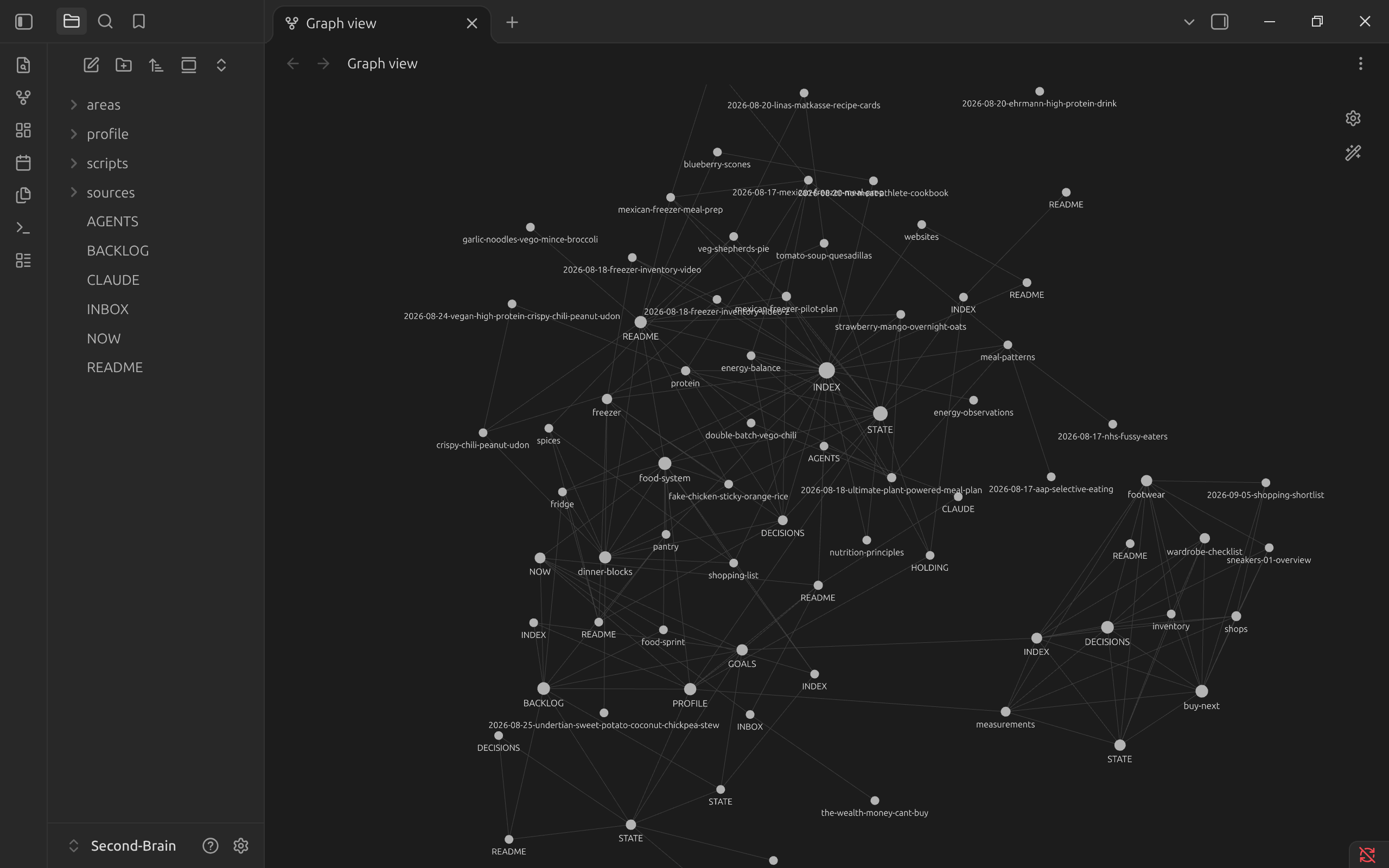
Obsidian gives me a way to browse those files and see links between notes. I expected to need that more than I do. Much of the time, I’m happy to work through the agent. I also switch between Claude and Codex: keeping the notes separate means I can bring the same underlying context to either, rather than leave it all inside one provider’s conversations.
Getting my finances in order
One useful example has been a financial tidy-up. There were several things to keep track of: where different assets were held, what needed attention, what I’d already dealt with and what was still in progress. The agent helped me keep that picture up to date, so I didn’t have to hold every open task in my head.
I chose to record where things were rather than include balances or account details. I could add more detail and use it to help work out my net worth, but for now I’m keeping that information out for privacy. This is about organising the work, rather than giving the system my complete financial life.
Keeping it current through conversation
I can talk through an update on my phone while walking or at the gym, then ask the agent to help update the notes. That lowers the effort of keeping the system current. I don’t have to wait until I’m sitting down and ready to organise a page.
That’s the part I’m interested in as a product person: whether changing the interaction makes the information more useful. Capturing more notes isn’t the goal. Helping me keep track of things and follow through is.
A second brain that can change its mind
One idea I haven’t implemented yet is a way to handle ageing information. Some notes stay useful for years; others describe a situation that has already changed. I’d like the system to flag stale information for review, give it less weight, and help revise or prune it when appropriate. Age alone wouldn’t make something wrong, and I wouldn’t want useful history disappearing automatically.
For now, that’s an idea rather than a feature. The agent can still misunderstand an update or rely on an old note, so I need to check what it records. This is an experiment in whether a second brain can become something I use regularly—and whether conversation makes that easier to sustain.